> ## Documentation Index
> Fetch the complete documentation index at: https://docs.promptlayer.com/llms.txt
> Use this file to discover all available pages before exploring further.
# Multi-Turn Chat
Building reliable conversational AI systems requires careful management of state and conversation history. This guide explains how to implement multi-turn chat using PromptLayer's stateless approach, which enhances reliability and makes your workflows easier to test and debug.
## Why Stateless Turns?
Traditional conversational AI systems often maintain complex internal state, making them difficult to debug, test, and scale. The stateless approach treats each turn of the conversation as an independent, deterministic function that receives all necessary context through input variables.
### The Black Box Approach
The best way to build reliable conversational AI is to treat each turn as a black box. You provide inputs (conversation history, current query, available tools) and receive outputs (response, tool calls, next actions). This approach optimizes for rapid development and iteration - you're simply crafting prompts in natural language and validating outputs. By building your conversational system around this principle, you enable quick prompt iterations and fast feedback cycles, which are essential for developing robust multi-turn interactions.
The stateless approach particularly shines when it comes to systematic evaluation of conversation flows. For a deeper dive into evaluating multi-turn conversations, check out our blog post on [best practices for evaluating back-and-forth conversational AI](https://blog.promptlayer.com/best-practi-to-evaluate-back-and-forth-conversational-ai-in-promptlayer/).
## Implementation Pattern
Here's the core pattern for implementing stateless multi-turn chat using [`promptlayer_client.run()`](/sdks/python#using-the-run-method-recommended):
### Basic Conversation (No Tools)
Maintain a running history of the conversation, adding each exchange as you go.
* Start with empty conversation history
* Loop:
* Send user question + history to PromptLayer
* Get AI response
* Add both to history
* Get next user question
* If no more questions, exit loop
```mermaid theme={null}
flowchart TD
Start([Start with empty history]) --> Input[Get user question]
Input --> Send[Send question + history to PromptLayer]
Send --> Response[Get AI response]
Response --> AddHistory[Add user question & AI response to history]
AddHistory --> NextInput{Get next user question}
NextInput -->|Has question| Send
NextInput -->|No question| End([End conversation])
```
```python theme={null}
def run_conversation(user_question):
chat_history = []
while True:
# For basic prompts without tools
result = promptlayer_client.run(
prompt_name="multi-turn-assistant",
input_variables={
"user_question": user_question,
"chat_history": chat_history
},
tags=["multi-turn-chat"]
)
# Extract the assistant's last message
last_message = result["prompt_blueprint"]["prompt_template"]["messages"][-1]
# Add to conversation history
chat_history.append({
"role": "user",
"content": [{"type": "text", "text": user_question}]
})
chat_history.append(last_message)
# Get next user input
user_question = get_next_user_input()
if not user_question:
break
return last_message if 'last_message' in locals() else None
```
### Conversation with Tools
The AI can make multiple tool calls before responding, accumulating results in a separate message buffer. For a deeper understanding of when and how to use tool calling, check out our blog post on [tool calling with LLMs](https://blog.promptlayer.com/tool-calling-with-llms-how-and-when-to-use-it/).
* Start with empty history and empty tool messages
* Loop:
* Send user question + history + tool messages to PromptLayer
* Get AI response
* If AI wants to use tools:
* Add AI message to tool messages
* Execute each tool
* Add tool results to tool messages
* Loop back (AI might need more tools)
* Else (final response):
* Add everything to history
* Clear tool messages for next turn
* Get next user question
```mermaid theme={null}
flowchart TD
Start([Start with empty history & tool messages]) --> Input[Get user question]
Input --> Send[Send question + history + tool messages to PromptLayer]
Send --> Response[Get AI response]
Response --> CheckTools{AI wants to use tools?}
CheckTools -->|Yes| AddToolCall[Add AI message to tool messages]
AddToolCall --> ExecuteTool[Execute each tool]
ExecuteTool --> AddToolResult[Add tool results to tool messages]
AddToolResult --> Send
CheckTools -->|No - Final response| AddToHistory[Add everything to history]
AddToHistory --> ClearTools[Clear tool messages]
ClearTools --> NextInput{Get next user question}
NextInput -->|Has question| Send
NextInput -->|No question| End([End conversation])
```
```python theme={null}
def run_conversation_with_tools(user_question):
chat_history = []
ai_in_progress = [] # Messages from AI's tool interactions
while True:
# With tools, include ai_in_progress for multi-step operations
result = promptlayer_client.run(
prompt_name="multi-turn-assistant-with-tools",
input_variables={
"chat_history": chat_history,
"user_question": user_question,
"ai_in_progress": ai_in_progress # [AI call, tool response, AI call, tool response, ...]
},
tags=["multi-turn-chat"]
)
last_message = result["prompt_blueprint"]["prompt_template"]["messages"][-1]
# Check if conversation should end
function_call = last_message.get("function_call")
if function_call and function_call.get("name") == "end_conversation":
return last_message if 'last_message' in locals() else None
# Handle tool calls - AI might need multiple tool calls before responding
if last_message.get("tool_calls") or last_message.get("function_call"):
# Add AI's message with tool call to ai_in_progress
ai_in_progress.append(last_message)
# Execute tool and add response
if last_message.get("tool_calls"):
for tool_call in last_message["tool_calls"]:
tool_result = execute_tool(tool_call)
ai_in_progress.append({
"role": "tool",
"content": [{"type": "text", "text": str(tool_result)}],
"tool_call_id": tool_call["id"]
})
elif last_message.get("function_call"):
tool_result = execute_tool(last_message["function_call"])
ai_in_progress.append({
"role": "function",
"name": last_message["function_call"]["name"],
"content": str(tool_result)
})
# Loop continues - AI can make another tool call or respond to user
else:
# AI provided final response - add everything to history
chat_history.append({
"role": "user",
"content": [{"type": "text", "text": user_question}]
})
# Add any tool interactions from ai_in_progress to history
if ai_in_progress:
chat_history.extend(ai_in_progress)
# Add final response
chat_history.append(last_message)
# Clear ai_in_progress for next user turn
ai_in_progress = []
# Get next user input
user_question = get_next_user_input()
if not user_question:
break
return last_message if 'last_message' in locals() else None
```
You can also implement this pattern using workflows for more complex pipelines with multiple nodes and conditional logic. See [Running Workflows](/sdks/python#running-workflows) for details on using `promptlayer_client.run_workflow()`.
## Designing Your Stateless Prompt
Your prompt template should be designed to receive all necessary state through input variables. Here's an example of a properly configured multi-turn assistant with tools:
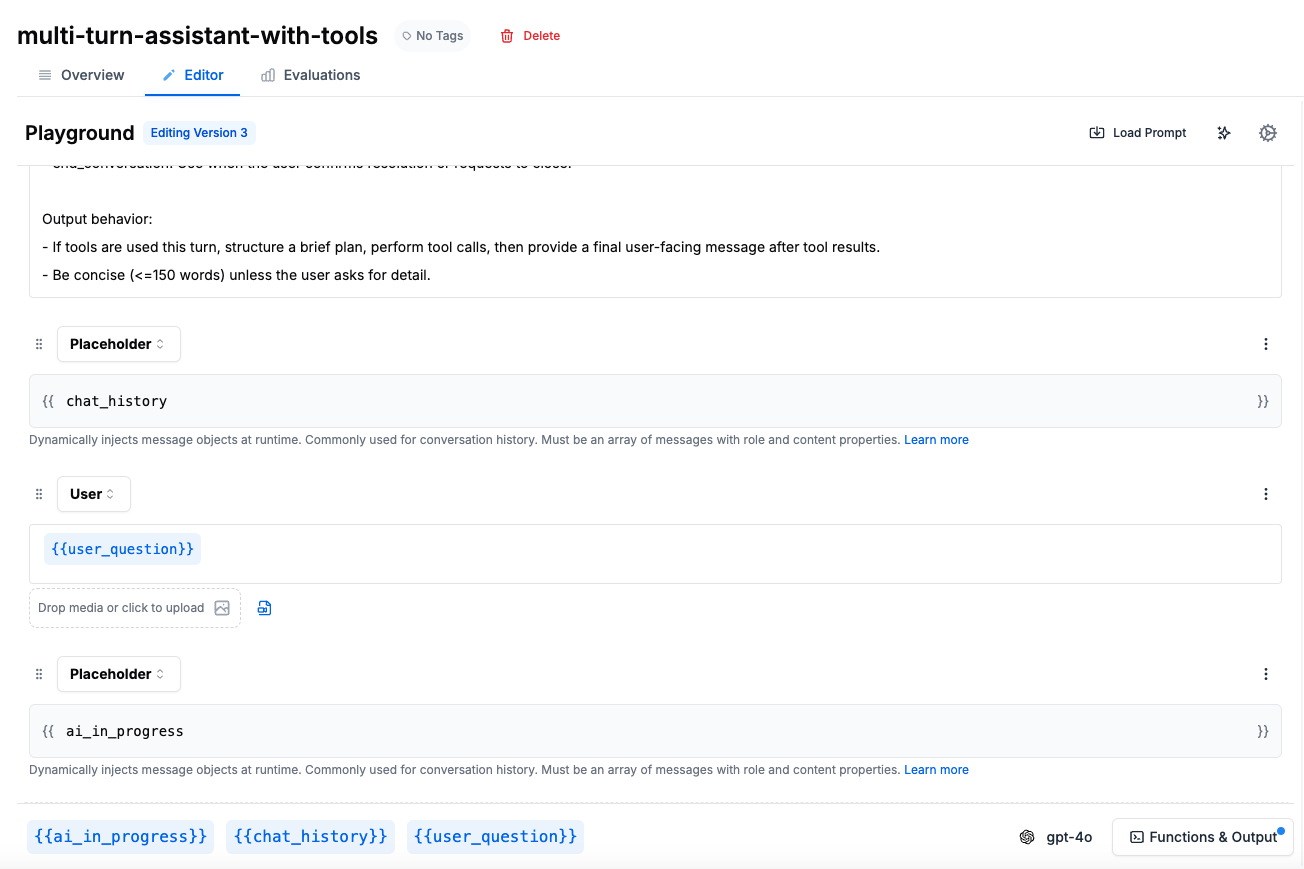 Notice how the prompt template includes:
* A system message with instructions and tool usage behavior
* Placeholder for `{{chat_history}}` to inject conversation context
* User message with `{{user_question}}`
* Placeholder for `{{ai_in_progress}}` to handle tool interactions
### Required Input Variables
1. **chat\_history**: Array of previous messages in the conversation
2. **user\_question**: The current user message or query
3. **ai\_in\_progress**: Array of messages representing ongoing tool interactions (only used with tools, placed AFTER user\_question)
### Understanding ai\_in\_progress
The `ai_in_progress` variable is specifically for handling multi-step tool interactions where the AI needs to make multiple tool calls before responding to the user. It's placed AFTER the user\_question because it represents the AI's response to that question. It contains a sequence of messages like:
* AI's tool call (in response to user\_question)
* Tool's response
* AI's next tool call
* Tool's response
* Final AI message to user
This allows the AI to perform complex operations (like searching, then filtering, then formatting results) without requiring user input between each step. Once the AI provides a final response, all these messages are moved to chat\_history for the next turn. If your prompt doesn't use tools, you can omit this variable entirely.
### Using Message Placeholders
[Message Placeholders](/features/prompt-registry/placeholder-messages) are crucial for injecting conversation context into your prompts. They allow you to dynamically insert the conversation history into your prompt template. For more details on template variables and dynamic prompts, see our [Template Variables](/features/prompt-registry/template-variables) guide:
```python theme={null}
# In your prompt template, use placeholders:
# Role: placeholder
# Content: {{chat_history}}
#
# Role: user
# Content: {{user_question}}
# For basic conversations without tools:
promptlayer_client.run(
prompt_name="multi-turn-assistant",
input_variables={
"chat_history": [
{
"role": "user",
"content": [{"type": "text", "text": "What's the weather?"}]
},
{
"role": "assistant",
"content": [{"type": "text", "text": "I'll check the weather for you."}]
}
],
"user_question": "How about tomorrow?"
}
)
# For conversations with tools, add ai_in_progress after user_question:
# Role: placeholder
# Content: {{chat_history}}
#
# Role: user
# Content: {{user_question}}
#
# Role: placeholder
# Content: {{ai_in_progress}}
```
## Handling Tool Calls
For workflows that use tools, maintain tool state externally. See our [Tool Calling](/features/prompt-registry/tool-calling) documentation for setting up tool definitions in your prompts:
```python theme={null}
def handle_tool_execution(agent_response, tool_registry):
"""Execute tools and prepare results for next turn"""
if not agent_response.get("tool_calls"):
return None
tool_results = []
for call in agent_response["tool_calls"]:
tool = tool_registry.get(call["name"])
if tool:
result = tool.execute(call["arguments"])
tool_results.append({
"tool": call["name"],
"call_id": call["id"],
"result": result
})
return tool_results
```
## Integration with Evaluation
The stateless approach makes it easy to evaluate your conversational AI:
1. **Record real conversations** as sequences of inputs and outputs
2. **Replay conversations** with modified parameters to test variations
3. **Evaluate individual turns** for quality and correctness
4. **Test edge cases** by crafting specific conversation states
Learn more about setting up comprehensive evaluations in our [Evaluation and Ranking](/features/evaluations/overview) guide.
## Next Steps
* Explore [Message Placeholders](/features/prompt-registry/placeholder-messages) for dynamic prompt construction
* Set up [Evaluations](/features/evaluations/overview) for your conversational flows
* Learn about [Workflow development](/why-promptlayer/workflows) for complex pipelines
* Read our guide on [Tool Calling](/features/prompt-registry/tool-calling) for implementing tool-enabled assistants
* Check out [Structured Outputs](/features/prompt-registry/structured-outputs) for formatted responses
Notice how the prompt template includes:
* A system message with instructions and tool usage behavior
* Placeholder for `{{chat_history}}` to inject conversation context
* User message with `{{user_question}}`
* Placeholder for `{{ai_in_progress}}` to handle tool interactions
### Required Input Variables
1. **chat\_history**: Array of previous messages in the conversation
2. **user\_question**: The current user message or query
3. **ai\_in\_progress**: Array of messages representing ongoing tool interactions (only used with tools, placed AFTER user\_question)
### Understanding ai\_in\_progress
The `ai_in_progress` variable is specifically for handling multi-step tool interactions where the AI needs to make multiple tool calls before responding to the user. It's placed AFTER the user\_question because it represents the AI's response to that question. It contains a sequence of messages like:
* AI's tool call (in response to user\_question)
* Tool's response
* AI's next tool call
* Tool's response
* Final AI message to user
This allows the AI to perform complex operations (like searching, then filtering, then formatting results) without requiring user input between each step. Once the AI provides a final response, all these messages are moved to chat\_history for the next turn. If your prompt doesn't use tools, you can omit this variable entirely.
### Using Message Placeholders
[Message Placeholders](/features/prompt-registry/placeholder-messages) are crucial for injecting conversation context into your prompts. They allow you to dynamically insert the conversation history into your prompt template. For more details on template variables and dynamic prompts, see our [Template Variables](/features/prompt-registry/template-variables) guide:
```python theme={null}
# In your prompt template, use placeholders:
# Role: placeholder
# Content: {{chat_history}}
#
# Role: user
# Content: {{user_question}}
# For basic conversations without tools:
promptlayer_client.run(
prompt_name="multi-turn-assistant",
input_variables={
"chat_history": [
{
"role": "user",
"content": [{"type": "text", "text": "What's the weather?"}]
},
{
"role": "assistant",
"content": [{"type": "text", "text": "I'll check the weather for you."}]
}
],
"user_question": "How about tomorrow?"
}
)
# For conversations with tools, add ai_in_progress after user_question:
# Role: placeholder
# Content: {{chat_history}}
#
# Role: user
# Content: {{user_question}}
#
# Role: placeholder
# Content: {{ai_in_progress}}
```
## Handling Tool Calls
For workflows that use tools, maintain tool state externally. See our [Tool Calling](/features/prompt-registry/tool-calling) documentation for setting up tool definitions in your prompts:
```python theme={null}
def handle_tool_execution(agent_response, tool_registry):
"""Execute tools and prepare results for next turn"""
if not agent_response.get("tool_calls"):
return None
tool_results = []
for call in agent_response["tool_calls"]:
tool = tool_registry.get(call["name"])
if tool:
result = tool.execute(call["arguments"])
tool_results.append({
"tool": call["name"],
"call_id": call["id"],
"result": result
})
return tool_results
```
## Integration with Evaluation
The stateless approach makes it easy to evaluate your conversational AI:
1. **Record real conversations** as sequences of inputs and outputs
2. **Replay conversations** with modified parameters to test variations
3. **Evaluate individual turns** for quality and correctness
4. **Test edge cases** by crafting specific conversation states
Learn more about setting up comprehensive evaluations in our [Evaluation and Ranking](/features/evaluations/overview) guide.
## Next Steps
* Explore [Message Placeholders](/features/prompt-registry/placeholder-messages) for dynamic prompt construction
* Set up [Evaluations](/features/evaluations/overview) for your conversational flows
* Learn about [Workflow development](/why-promptlayer/workflows) for complex pipelines
* Read our guide on [Tool Calling](/features/prompt-registry/tool-calling) for implementing tool-enabled assistants
* Check out [Structured Outputs](/features/prompt-registry/structured-outputs) for formatted responses